
At Good Tech Collective, we support the development of responsible technology. Technology that doesn’t harm people. Technology that actually makes the world better.
Tech shapes almost everything we do now. We need to ask: How do we use this power without losing our humanity or destroying our planet? Our digital lives shouldn’t damage our mental health, invade our privacy, or break our human connections. Technology should serve human values. Not the other way around. And since we’re part of a larger living ecosystem, truly responsible tech must think about our impact on the planet too.
A Manifesto for Ecological Innovation
(ecological innovation: technology designed in harmony with living systems: humans, other species, the entire earth)
1. Good Tech
We live in a technological age. AI systems can write, create, and (seem to) reason. Digital platforms connect billions of people instantly. Yet for all this power, we see more anxiety, division, and disconnection.
The problem isn’t technology itself. It’s how we build it. Most tech development focuses on metrics that boost engagement, growth, and profit. It ignores deeper human needs and long-term consequences.
Good tech needs more than good intentions. It requires:
- Responsible AI practices that put human agency and wellbeing first
- Digital products designed for genuine human thriving, not addiction
- Development processes that consider effects on society, mental health, and democracy
- Teams that model healthy relationships with technology themselves
This isn’t about slowing innovation—It’s about pointing our technical abilities and innovation efforts toward outcomes that actually serve humanity.
2. Ownership and Incentives
How we structure ownership and incentives in tech shapes the kind of technology we create. When ownership stays narrow and incentives focus only on growth and profits, leaders get pushed to focus on narrow metrics. They ignore the broader effects of their work on society and the environment.
While most founders begin with the best intentions, the existing systems often steer them toward a growth-only mindset. This dynamic can lead to technologies that prioritize addictive engagement, data exploitation, or environmental harm over long-term human and planetary wellbeing. It also leads to an effect that Cory Doctorow has called “enshittification”, where products reach a point where the only way to still grow is making the user experience actively worse.
To create truly good tech, we need to rethink these structures:
- Explore ownership models that spread power and accountability more fairly
- Design incentive systems that reward long-term value creation over short-term gains
- Encourage leaders to think about how their decisions affect society, democracy, and the environment
When we align ownership and incentives with human and ecological wellbeing, technology can serve the common good.
3. Wisdom in Business
How do we consistently make wise, responsible choices, especially under the pressures of startup life, investor demands, and competitive markets? This is where wisdom traditions offer something powerful: practices that develop our capacity for wise decision-making.
When leaders are more grounded, embodied, reflective, and connected to something bigger than immediate profit, they naturally make choices that serve long-term wellbeing. They pause before reacting. They consider broader consequences. They stay connected to their deepest values even when facing difficult trade-offs.
Business wisdom isn’t mystical. It’s practical. It’s about building the inner capacity to:
- Make decisions from clarity rather than reactivity
- Think about multiple stakeholders and long-term impacts
- Stay aligned with core values under pressure
- Lead with both competence and compassion
This approach applies far beyond tech. Any business facing complex decisions in an interconnected world can benefit from leaders who bring both strategic intelligence and embodied wisdom to their work.
The Collective
We’re not a consultancy. We’re a community of practitioners — consultants, coaches, founders, and organizations — who share these commitments.
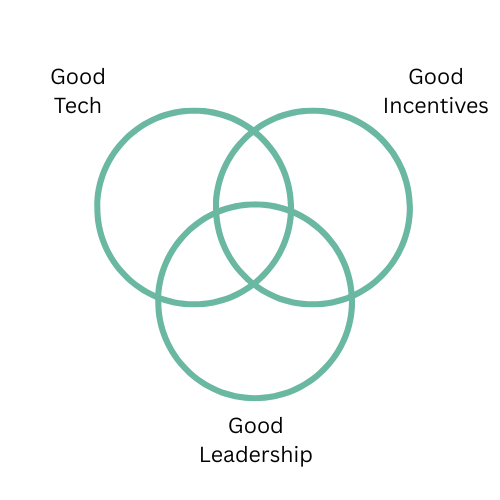
Some of us focus on responsible AI. Some on ownership structures. Some on leadership development. What connects us is the belief that these domains need each other. That responsible technology isn’t just a technical problem or a policy problem or a leadership problem — it’s all three, intertwined.
We’re early. We’re building this in the open, learning as we go, and looking for others who see it the same way.
Join Us
If this resonates, we’d like to hear from you.
- Practitioners and consultants working in responsible tech, alternative ownership, or leadership development
- Founders and executives trying to build differently and looking for support
- Organizations aligned with these values who want to be part of the network
We’re not asking you to buy anything. We’re asking if you want to be part of the conversation.
[Join the Slack] | [Reach out directly: email]
About
Good Tech Collective was founded by Iris van de Kieft.
After years in the tech industry, my perspective shifted from “tech is awesome” to “wait, we have a lot of responsibility to build tech well” — I became convinced that responsible technology requires more than better principles. It requires a different kind of capacity. And it requires structures that support good decisions rather than undermining them.
I started this collective to find others who see it the same way — and to figure out, together, what it looks like to build technology worthy of the power we now hold.